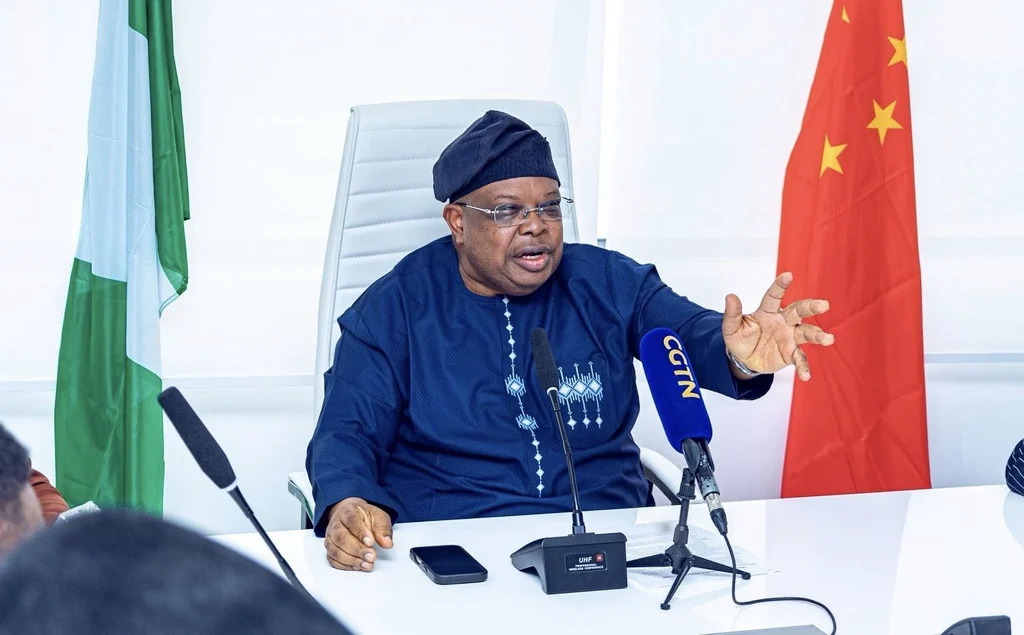
On Friday, November 6, 2026, Power Minister Joseph Tegbe and Comptroller-General of Customs, Bashir Adewale Adeniyi, stood at the ENL Terminal in Apapa, Lagos, and announced a “breakthrough” for the ages: Customs had releasing 98 of about 300 containers of transmission equipment that had been abandoned at Nigerian ports for 14 to 20 years.
The equipment was bought to expand the grid and relieve overloaded substations, and it sat in port while you sat in the dark. Let鈥檚 dig into that.
Twenty years of nobody鈥檚 problem
Tegbe the containers remained at the ports due to unpaid charges and unresolved clearance procedures. Now, Customs is the accumulated charges at President Tinubu鈥檚 instruction. So the money that supposedly blocked the cargo for two decades vanished with one directive.
For 20 years, Nigerians paid for blackouts with generator fuel, inverters and spoiled food. The solution was one directive away the whole time.
So who was in charge while the cargo sat there? Nine ministers have run the power sector in that time. Did none of them know about it? If they did, why did nothing happen? If they didn鈥檛, what exactly were they overseeing? What about the heads of customs, the port authorities and the agencies that imported the equipment in the first place? Somewhere along the line, everybody had a chance to say something, and apparently nobody did.
D茅j脿 vu at the ports?
In 2018, Premium Times that Nigeria had recovered 693 containers of power equipment that had been abandoned at the ports for about 15 years. More recently, in August 2026, the Niger Delta Power Holding Company equipment from 110 containers and 216 packages after the Nigerian Ports Authority (NPA) intervened.
Every rescue is announced like a first. If agencies keep losing track of government cargo, you keep paying for equipment you never get to use.
Twenty years? How鈥檚 this even possible?
If you鈥檙e wondering how government equipment got stuck in government-owned ports for over a decade, you鈥檙e not alone.
The comes down to bureaucracy and lack of coordination. Different government bodies, such as the Ministry of Power, the Transmission Company of Nigeria (TCN), the Ministry of Finance, and Nigeria Customs, often disagree on import duties, waivers, and paperwork.
Customs requires specific documents, approvals, and fees before releasing any cargo, regardless of who owns it. Without clear waivers or payment for shipping charges, the containers simply sit at the ports unattended.
The Big Daily is your weekday shortcut to the biggest news shaping Nigeria. We cut through the noise, connect the dots, and explain why the news actually matters, all in one quick read.
Will the wires still wire?
The equipment high-capacity transformers, high-tension wire, cables, switchgear, and conductors, as well as towers for high-voltage lines. Comptroller-General of Customs Bashir Adewale Adeniyi items that no longer work will be disposed of in line with experts’ recommendations; this is French for “some of them may be useless,” meaning the money spent on buying them has likely been wasted.
We spoke to Professor Dayo Ayoade, a professor of energy law at the University of Lagos, to understand if the equipment stands any chance. The way he explained it, the equipment’s usefulness will ultimately come down to how it is stored because it is, by nature, built to last.
He also emphasised that testing won鈥檛 exactly guarantee the equipment is safe for us. He said, 鈥�…Even if we test it, this does not guarantee that it will be of use operationally; the risk we face is that you can install equipment that looks good in theory and passes those initial tests, but by the time you install it and it is put under pressure, it now fails and causes damage to connected infrastructure, causes deterioration of energy supplies, and that becomes another problem.鈥�
Just how insane is this?
As of October 2026, Nigeria had an installed of about 13,625 MW, but only about 5,151 MW (38%) is available for use. The gap between generation capacity and supply is obvious.
Old substations and overloaded wires cannot carry all the electricity that power plants produce, so power gets , and the grid fails. Keeping vital cables and switchgear trapped at the ports for about 20 years denied the grid the resources needed to deliver power to homes and businesses.
Between late December 2025 and January 2026, the national grid three times, following a weak pattern that saw it .
Unusable equipment sitting in ports reduces the electricity available to Nigerians, leaving businesses over $22 billion annually on generators to cope with power instability.
We deserve more accountability
Equipment meant to strengthen the power sector being stuck at ports for years is disturbing, especially given how easy the fix was.
Nobody should celebrate a government for clearing its own cargo after two decades, and nobody should accept 鈥渂etter late than never鈥� as the standard.
A country that鈥檚 can鈥檛 afford to leave grid equipment sitting at the port. If it took 20 years for anyone to notice, what else is sitting in a container somewhere?
With only 98 containers released so far, citizens must follow this issue to the end and demand full accountability for the remaining equipment still trapped at the ports.